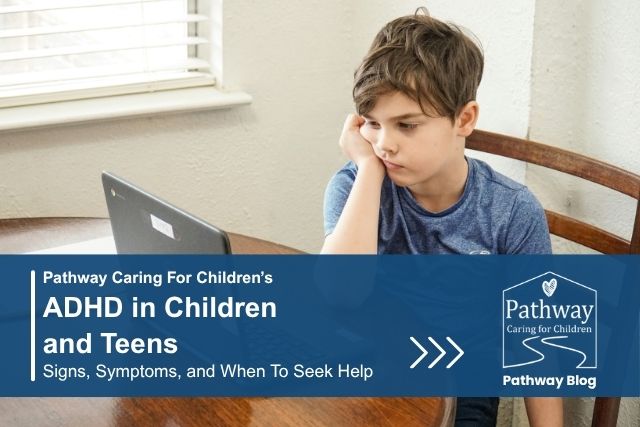
ADHD in Children and Teens: Signs, Symptoms and When to Seek Help

Marcie Girdlestone
View Marcie’s profile »ADHD can affect attention, activity level, impulse control and everyday routines. When difficulties persist across settings and interfere with daily life, an evaluation can help families understand what is happening and find useful support.
October is ADHD Awareness Month, a time to increase understanding of Attention-Deficit/Hyperactivity Disorder (ADHD) and reduce some of the misconceptions that still surround it.

When people hear “ADHD,” they may picture a child who can’t sit still, talks constantly, or is easily distracted. Those can certainly be signs of ADHD, but ADHD often looks much more complicated, particularly as children grow into adolescence.
A child who continually forgets homework, a teenager who waits until 10 p.m. to begin a project they’ve known about for two weeks, or a student who becomes overwhelmed and shuts down when given several instructions at once may not immediately make us think of ADHD.
Sometimes these behaviors are interpreted as laziness, defiance, irresponsibility, or a lack of motivation.
But there may be more happening beneath the behavior.
How Common Is ADHD in Children?
ADHD is one of the most common mental health conditions affecting children.
According to the Centers for Disease Control and Prevention (CDC), an estimated 7 million U.S. children ages 3–17 — 11.7% had a current ADHD diagnosis in 2024, based on a national survey of parents.
ADHD can range from mild to severe. In the 2022 national parent survey, about 6 in 10 children with current ADHD had symptoms rated moderate or severe.
ADHD also affects young people in our community. The 2022 Stark County Community Health Assessment reports that, in the 2021 Northeast Ohio Youth Health Survey, 17% of male students and 13% of female students reported having been told by a healthcare professional that they had ADD/ADHD before the current school year. These are historical student-reported figures, not current estimates for all Stark County children, and they are not directly comparable with the national parent survey.
These numbers matter because ADHD can affect much more than school performance. It can influence relationships, emotional regulation, organization, routines, confidence, and everyday family life.
What Does ADHD Look Like in Children and Teens?
ADHD is a neurodevelopmental disorder involving persistent patterns of inattention, hyperactivity, and/or impulsivity that interfere with daily functioning. Some children mainly struggle with attention; others show more hyperactivity and impulsivity; some experience both.
But those clinical words don’t always capture what ADHD looks like around the kitchen table at 7:30 on a school morning.
Parents may notice patterns such as:
Attention and memory
- Repeatedly forgetting homework, permission slips, water bottles or belongings
- Hearing an instruction and forgetting it moments later
- Needing repeated reminders to complete everyday routines
- Becoming distracted in the middle of a task
- Appearing to daydream or “zone out”
Organization and time
- Starting several tasks but struggling to finish them
- Having difficulty getting started on homework or chores
- Losing track of time
- Struggling to organize a backpack, bedroom or schoolwork
- Becoming overwhelmed by assignments with multiple steps
- Procrastinating until a deadline creates enough urgency to act
Impulses and emotions
- Interrupting conversations or answering before a question is finished
- Acting before thinking about the consequences
- Having difficulty waiting
- Fidgeting or needing frequent movement
- Having strong emotional reactions to frustration (an associated difficulty, rather than a defining ADHD symptom)
One of the most confusing things for parents can be inconsistency.
A child may focus intensely on a video game, art project, or favorite activity for an extended period but struggle to focus for 15 minutes on homework. A teenager may independently organize an entire social event but repeatedly forget to turn in completed assignments.
These examples can help parents notice patterns, but they cannot establish a diagnosis. Difficulty focusing on one activity does not mean a child cannot focus on anything, and strong focus on an enjoyable activity does not rule out ADHD.
ADHD Isn’t Just About Paying Attention
The name itself can be misleading.
ADHD can affect executive functioning: skills that help us plan, organize, remember information, manage time, and follow through. Difficulties with these skills can also occur alongside challenges managing emotions. Not every child experiences the same difficulties.
Think about how many executive-functioning skills a seemingly simple instruction requires: “Get ready for school.”
A child may need to get dressed, brush their teeth, find their shoes, pack their backpack, locate their Chromebook, remember their lunch and keep track of time so they do not miss the bus all while managing multiple visual and auditory distractions: the dog barking, the noise and movement on television, the microwave beeping, siblings arguing and pushing to get to the table first, parents giving last minute reminders….
For a child struggling with executive functioning, that’s not one task. It’s a series of tasks requiring planning, memory, organization, attention and time management.
This helps explain why simply telling a child to “try harder” often is not enough. A clear first step, a visual reminder or a predictable routine can make the task easier to manage.
Watch: The ADHD Iceberg – Carolina ADHD Coaching. This supplemental explainer uses an iceberg metaphor to describe less visible challenges; it is not a diagnostic tool.
Does ADHD Look Different in Girls?
It can.
Boys are diagnosed more often than girls. CDC reports that, in 2022–2023 national parent survey data, 13% of boys and 7% of girls had a current ADHD diagnosis. Diagnosis rates reflect who has been identified; they do not tell us that girls are unaffected.
That does not mean parents should assume ADHD is primarily a condition affecting boys.

Children with more obvious hyperactive or impulsive behavior may attract adult attention more quickly. A child who gets out of their seat repeatedly or frequently interrupts a class is difficult to overlook.
A child whose primary struggles involve attention may be much easier to miss.
A child whose difficulties are less disruptive may appear quiet, dreamy, disorganized, forgetful or overwhelmed. These attention difficulties deserve consideration in children of any gender.
Recognizing that ADHD does not look the same in every child is an important part of identifying children who may need support.
Is It ADHD or Typical Childhood Behavior?
Every child gets distracted.
Every teenager procrastinates sometimes.
Children forget things, interrupt, become frustrated, and occasionally make impulsive decisions. Those behaviors alone don’t mean a child has ADHD.
What matters is the pattern and the impact.
Occasional childhood behavior
A pattern worth evaluating
Occasional childhood behaviorSometimes forgets or gets distracted
A pattern worth evaluatingPersistent difficulties beyond what is expected for developmental level
Occasional childhood behaviorHappens occasionally or in one situation
A pattern worth evaluatingPresent across settings, such as home and school
Occasional childhood behaviorLimited effect on daily life
A pattern worth evaluatingInterferes with learning, relationships or routines
ADHD diagnosis involves more than noticing familiar behaviors. Symptoms must last at least six months, be present in two or more settings, cause impairment, and be inappropriate for the child’s developmental level. Some symptoms must have been present before age 12. A qualified professional also considers symptom counts and other possible explanations.
Parents may want to pay closer attention when difficulties:
- Happen frequently rather than occasionally
- Have persisted over time
- Occur in more than one environment
- Affect school performance
- Create frequent conflict at home
- Interfere with friendships
- Make everyday routines unusually difficult
- Affect a child’s confidence or self-esteem
It is also important not to assume that attention problems automatically mean ADHD.
Anxiety, depression, sleep difficulties, and other conditions can resemble ADHD. An evaluation helps distinguish these possibilities rather than assuming that every attention problem has the same cause.
ADHD and Emotional Health

The emotional side of ADHD deserves attention alongside academic performance. Some children have difficulty managing frustration or recovering from strong feelings. Emotional outbursts alone do not establish ADHD, and persistent distress deserves its own assessment.
Imagine regularly being told:
- Pay attention.
- Stop interrupting.
- You forgot again.
- Why didn’t you just do it?
- You need to try harder.
Over time, repeated correction can affect how children see themselves.
A child who genuinely intends to remember an assignment but repeatedly forgets it may eventually decide, I’m irresponsible.
A student who works harder than classmates but continues to struggle may conclude, I’m not smart.
A teenager who constantly disappoints adults despite wanting to do better may begin to believe, I can’t do anything right.
ADHD can occur alongside other mental health or developmental conditions, including anxiety, depression, learning disorders, and behavioral or conduct problems. Support should consider these needs as well.
That makes it important to look beyond the behavior itself.
What Can Parents Do to Help a Child With ADHD?
Support doesn’t mean lowering expectations. It means helping a child develop strategies that make expectations more manageable.
Parents can start by creating more structure around tasks that require executive functioning.
That might include:
- Breaking larger tasks into smaller steps
- Giving one or two instructions at a time
- Creating predictable morning and evening routines
- Using calendars, checklists and visual reminders
- Establishing consistent places for important belongings
- Providing movement breaks during homework
- Reducing unnecessary distractions
- Helping children estimate how long tasks will actually take
- Recognizing effort and progress—not only the finished result
Parents can also change the questions they ask.
Restructure your questions from:“Why didn’t you do this?”
To:“What got in the way of getting this done?”
Replace this question:“How many times do I have to remind you?”
With this question:“What could we put in place so you don’t have to rely on me to remind you?”
The goal isn’t to eliminate responsibility. It’s to gradually help children develop the skills and systems they need to become more independent.
When Should Parents Consider Professional Help?
Consider talking with a mental health professional when attention, impulsivity, organization, emotional regulation or related behaviors are consistently interfering with a child’s daily functioning.
There is no single test that establishes ADHD. An evaluation should consider a child’s history, daily functioning, and information from more than one setting.
A qualified professional may gather information from caregivers and teachers, use standardized rating scales, and consider other explanations for the difficulties. Screening questionnaires are one part of this process, not a diagnosis on their own.
Seeking an evaluation doesn’t mean deciding in advance that your child has ADHD. It means trying to better understand what’s happening.
ADHD Treatment and Support
There isn’t one approach that’s right for every child.
Treatment depends on age and individual needs. Evidence-based options include behavior therapy, parent training in behavior management, school supports, and medication when appropriate. For children younger than six, CDC highlights parent training in behavior management as the recommended first approach before medication is tried.
Access to treatment remains a concern. In the 2022 national parent survey, nearly 2 million U.S. children with current ADHD had received neither ADHD medication nor ADHD-specific behavioral treatment. That does not necessarily mean they received no other support.
Counseling can help address related concerns such as anxiety, self-esteem, relationships, coping, and family stress. ADHD-specific behavioral treatment and parent training have a distinct role; general supportive counseling should not be presented as interchangeable with those approaches.
Most importantly, treatment should focus on the whole child, not simply reducing behaviors that parents, teachers or other adults find frustrating.

Understanding the Child Behind the Behavior

Children with ADHD have strengths, interests, personalities and abilities that extend far beyond a diagnosis.
The goal isn’t to excuse challenging behavior. It’s to understand what’s contributing to it so children can develop the skills they need to succeed.
Sometimes that begins with changing the question.
There’s a difference in asking:“Why won’t they?”
And asking:“What’s getting in their way?”
That small shift moves you as a caregiver from frustration to curiosity and helps to change how you respond to a child who is struggling.
Pathway Caring for Children Can Help
At Pathway Caring for Children, our mental health professionals work with children, teens, and families experiencing a variety of emotional, behavioral and mental health concerns.
Our therapists and mental health professionals help families understand challenging behaviors, identify strengths and needs, and practice strategies for home, school and everyday life. We involve caregivers as appropriate so skills practiced in sessions can carry into daily routines.
If concerns about attention, impulsivity, emotional regulation, anxiety, behavior, or school functioning are affecting your child or family, you don’t have to wait until things reach a crisis point to seek support.
To ask about counseling for your child or teen, call Pathway Caring for Children at 330-493-0083 or visit our counseling enrollment page. Our team can discuss your concerns and help identify next steps.
Sources and further reading
- Centers for Disease Control and Prevention. (2026, July 8). Data on ADHD in children. Includes 2024 diagnosis estimates and findings from the 2022 national parent survey. Read source
- Stark Community Health Needs Assessment Advisory Committee. (2022; updated January 2023). 2022 Stark County Community Health Assessment (p. 96, “Youth: History of Mental Health Issues”). Data source: 2021 Northeast Ohio Youth Health Survey. Read source
- National Institute of Mental Health. (n.d.). Attention-deficit/hyperactivity disorder: What you need to know. Read source
- Centers for Disease Control and Prevention. (n.d.). Diagnosing ADHD. Read source
- Centers for Disease Control and Prevention. (n.d.). Treatment of ADHD. Read source
- Groves, N. B., et al. (2022). Executive functioning and emotion regulation in children with and without ADHD. Research on Child and Adolescent Psychopathology, 50, 721–735. https://doi.org/10.1007/s10802-021-00883-0. Read source
Educational information; an individual assessment is needed to determine a diagnosis.